By Wataru Tanaka
The Japan Rail Pass used to be something you bought on autopilot; the October 2023 price revision ended that era, and at ¥50,000 for seven days the pass now splits travelers into two clear groups — people who should buy one, and people who shouldn’t. From October 2026, where you buy becomes part of the decision too (the announced change applies to overseas agency purchases — details below). Five minutes from now you’ll know which side you’re on, and this guide follows through on both: which pass and how to buy it if you’re in, how to book bullet-train tickets on your own if you’re out. I don’t sell passes, and as a resident of Japan I’m not even eligible to use one — so I have no reason to push you toward either answer.
This article may contain affiliate links. If you book or buy through these links, Japan Moves may receive a small commission at no additional cost to you. Japan Moves does not act as your travel agent or booking intermediary through these links.
Prices and conditions verified as of July 2026. Always confirm current figures on the official pages linked below.
The short answer: two kinds of travelers — find your side in five minutes
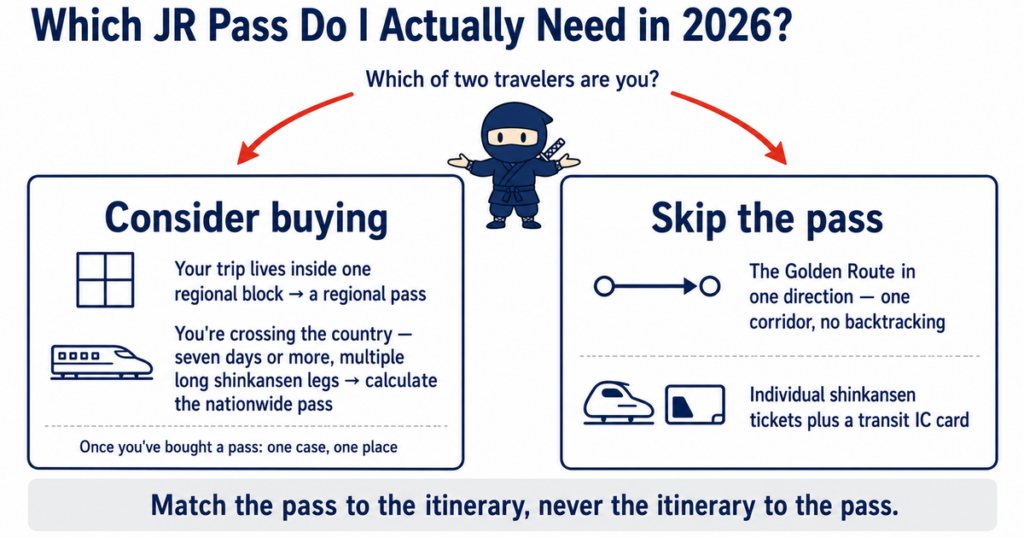
Is a JR Pass worth it in 2026? Do you even need one? Both questions have the same honest answer: it depends which of two travelers you are — and finding out takes five minutes, not fifteen browser tabs.
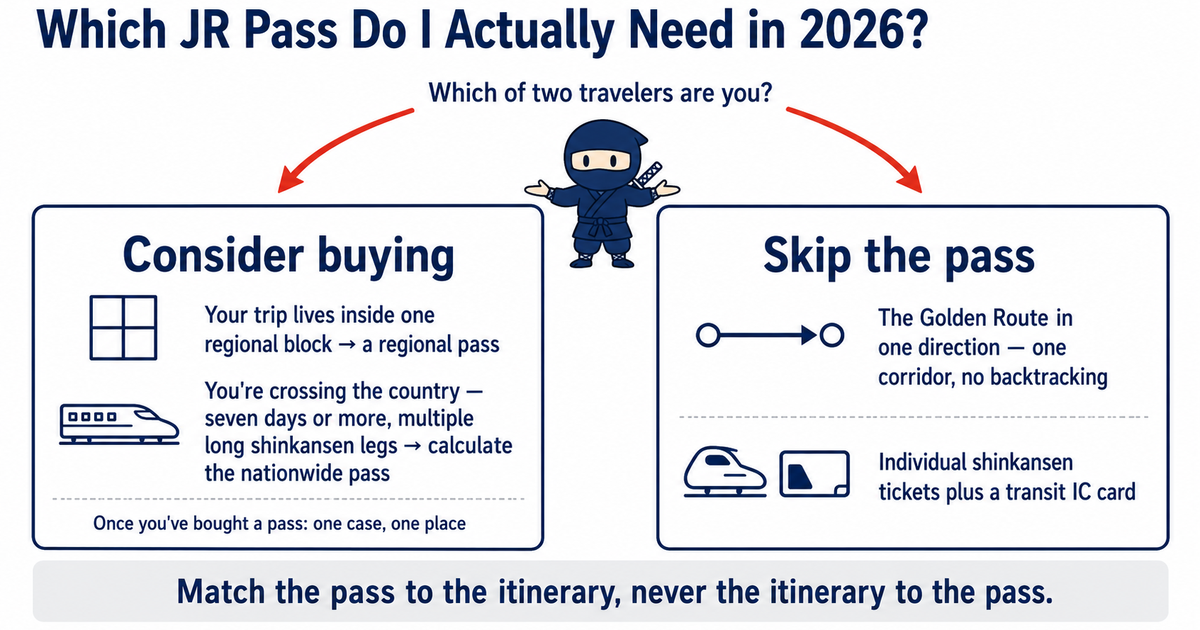
You’re on the buying side if either of these is true:
- Your trip lives inside one regional block — Kansai plus the San’in coast, say, or a Tokyo base with trips fanning out, or a Kyushu loop. Then the question isn’t the nationwide pass at all; it’s which regional pass matches your block, and those are covered in the next section.
- You’re crossing the country — seven days or more, multiple long shinkansen legs, something like Tokyo in and Osaka out with detours. Then the nationwide pass deserves a real calculation, and the itinerary patterns below walk through it.
If you land here, there’s one more thing waiting for you further down this page: the single piece of preparation I’d insist on once you’ve bought a pass. I’ve seen what happens to travelers who skip it.
You’re on the skipping side if:
- Your itinerary is the Golden Route in one direction — Tokyo, maybe Hakone or Nagoya, Kyoto, Osaka, out. One corridor, no backtracking. For that trip, individual shinkansen tickets plus a transit IC card do the job, and you can close the pass tab right now. The how-to is in the individual-tickets section below, because deciding not to buy still deserves a working plan.
If you’re torn between the boxes, here’s my rule: decide only which box your itinerary falls into. Choosing the exact pass — or the exact tickets — comes after, and both paths are laid out on this page. Don’t pick a pass and then bend your trip around it; that’s backwards, and it’s the single most common JR Pass mistake.
One thing to be clear about before we start: Japan Moves does not sell or arrange rail passes. Whatever you decide, you’ll buy it yourself, on the official sites or through a JR-designated sales agent.
What changed: prices and where you buy
Three facts explain why the old “just get the pass” advice died, and why 2026 adds a wrinkle of its own.
First, the 2023 revision was not a tweak. From October 1, 2023, the 7-day ordinary pass went to ¥50,000 — from ¥29,650 at overseas sales agents and ¥33,610 on the official website before the change (JR Group notice, July 2023). The 14-day rose from ¥47,250/¥52,960 to ¥80,000, the 21-day from ¥60,450/¥66,200 to ¥100,000. Notice the detail most summaries skip: prices used to differ by sales channel even then. Keep that thought.
Second, the pass changed character, not just price. The same notice that raised the price also created the ticket that lets pass holders board the fastest trains (the Nozomi and Mizuho — covered properly below) and announced discounts at tourist facilities. Read the product, not the outrage: this stopped being a blanket discount and became a convenience good. Whether a convenience good is worth ¥50,000 depends entirely on your itinerary — which is why a sorting guide beats a verdict.
Third, the 2026 wrinkle: channel pricing is back. For purchases from October 1, 2026, the JR Group has announced revised prices for passes bought through overseas designated sales offices and agencies — 7-day ordinary ¥53,000, 14-day ¥84,000, 21-day ¥105,000; Green Car ¥74,000/¥116,000/¥147,000 (JR West press release, April 2026; JR East PDF). Here is the part I want to state carefully, because it’s an observation, not a promise: as of July 2026, the official price page attaches the October revision note only to overseas-agency purchases; it lists no corresponding revision for purchases made online. I’m not going to translate an absence of a note into “online stays cheaper” — announcements can follow. What it does mean is this: from October 2026, where you buy is a real variable. Before paying, put the official online price and your local agency’s price side by side and look.
Everything date-dependent in this article lives in this section. If you’re reading this after another revision lands, the prices above are what to re-check first; the decision logic below doesn’t expire.
Nationwide JR Pass vs regional passes
The principle, stated plainly: if your itinerary fits inside one or two regions, a regional pass almost always fits it better than the nationwide one. The nationwide pass earns its price on one specific shape of trip — the long traverse. Everything else is detail. But two details matter enough to say before the itinerary patterns:
Detail one: the fastest trains cost extra even for pass holders. The nationwide pass does not cover the Nozomi (Tokaido/Sanyo line) or the Mizuho (Sanyo/Kyushu line) — the express services that skip the most stops. Riding them requires a separate purchase, officially named the “[ONLY WITH JAPAN RAIL PASS] NOZOMI MIZUHO Ticket”, sold only to pass holders and priced per section — for example ¥4,960 for Tokyo–Kyoto and ¥6,500 for Tokyo–Hiroshima, same price whether reserved, non-reserved, or Green Car (official ticket page, as of July 2026). Without it, pass holders take the Hikari, Kodama, or Sakura — same tracks, more stops. This constraint shapes the westbound patterns below more than any other single fact.
Detail two: the regional-pass landscape moved hard in early 2026 — distrust older articles. Three examples from this year alone: JR East reorganized its visitor passes — the former area passes such as the Tohoku Area Pass ended sales in March 2026, replaced by a single JR EAST PASS covering the JR East network in 5-day and 10-day versions (current prices and conditions on JR East’s pass page). The Hokuriku Arch Pass had its price and validity revised on March 14, 2026 (official page). And JR West’s current pass list is the place to check which of its area passes exist this season — the lineup is not what 2024 blog posts describe. The rule this teaches: pick the pass from the operator’s official list, this month, not from a saved article — this one included. The links here are where to look; the current prices are yours to read on arrival.
My editorial stance, since a sorting guide owes you one: for each destination block there is usually one regional pass worth checking first — named pattern by pattern below — rather than five to compare. Comparing five passes is how an evening disappears.
Your itinerary, your answer
Six itinerary shapes cover most first and second trips to Japan. Find yours; each verdict comes with its reasoning and its trap.
Golden Route only: Tokyo → Kyoto → Osaka, one direction
Verdict: skip the pass. One corridor, no return leg, no side trips — this is exactly the trip the ¥50,000 pass no longer fits. Price your actual legs on the official fare finders (five minutes, method in the next section) and hold the total against ¥50,000; for a one-way Golden Route it is unlikely to come close. The trap here is psychological, not financial: buying a pass “to be safe” and then feeling obliged to use it. As for the trains themselves — I’ve done this stretch myself. The Hikari, the train pass holders default to because the Nozomi costs extra, is perfectly workable between Tokyo and Osaka: same line, same seats, a few more stops. On this corridor, the fast-train question isn’t worth losing sleep over in either direction.
Golden Route plus Hiroshima and Miyajima
Verdict: this is the classic borderline case — calculate, don’t guess. A Tokyo–Kyoto–Osaka–Hiroshima trip with a return to Tokyo is where the 7-day nationwide pass starts to argue for itself. Three variables decide it: whether you return by rail or fly out of a western airport; how many intermediate hops you add; and how you feel about train speed. On that last one, from experience riding these corridors: the further west you go, the more the Nozomi exclusion matters. Between Tokyo and Osaka the exclusion is livable — though I’ll be straight about my own habit: on this stretch, on my own tickets, I usually pick the Nozomi, the very train the pass leaves out. Push on toward Okayama and Hiroshima and it stops being livable and becomes genuinely tough: the extra stops stack up ride after ride, and a pass holder either sits through them or budgets the NOZOMI MIZUHO Ticket — ¥6,500 for Tokyo–Hiroshima, per ride, on top of the pass. And at this distance, a domestic flight becomes a realistic alternative worth pricing before you commit to rail at all. Run all three numbers — pass plus supplements, individual tickets, and the flight — and the answer will be obvious for your dates. It genuinely differs trip by trip.
Tokyo base, with radial trips (Nikko, Kanazawa, the Alps)
Verdict: buying side — but a regional pass, not the nationwide one. If you sleep in Tokyo and fan outward, you never use the western half of the nationwide pass, which means you’re paying for track you’ll never ride. The first place to look is the reorganized JR EAST PASS (see the previous section for the 2026 changes); if your fan reaches Kanazawa and continues to Osaka in an arc, the Hokuriku Arch Pass draws exactly that Tokyo–Kanazawa–Osaka curve — check its post-March-2026 price and conditions on the official page. The trap: radial itineraries change shape easily. Fix your day trips first, then choose the pass — not the reverse.
Kansai base, adding the San’in coast (Tottori, Matsue, Izumo)
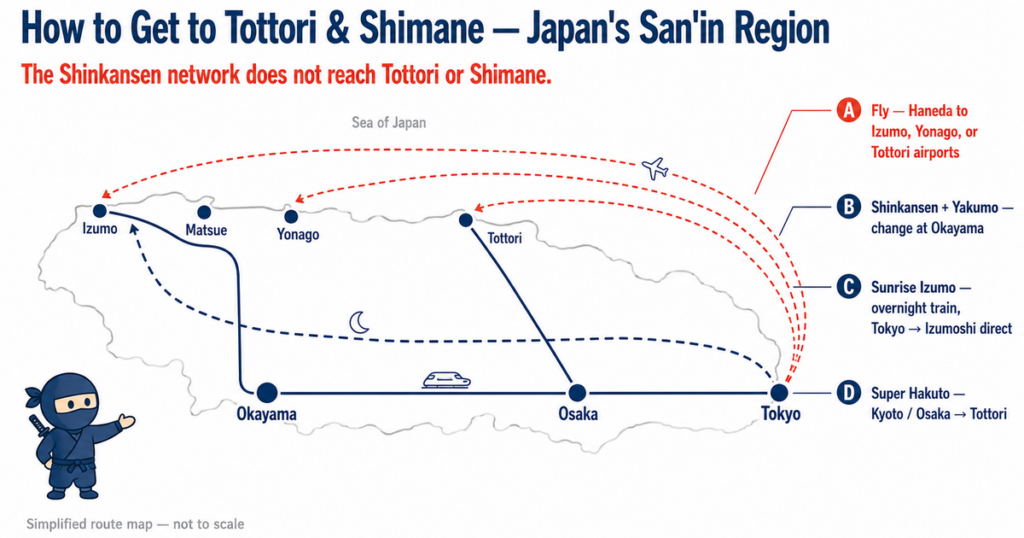
Verdict: buying side — JR West’s regional passes are the tool. Kansai plus San’in is a well-supported shape: on JR West’s current lineup, the Kansai-San’in Area Pass covers exactly this combination, and the Sanyo-San’in Area Pass widens it to Hiroshima and the south coast if you’re looping. Check current prices on the official list — and see the 2026 caution above about lineup changes. Getting to and around the San’in region has enough moving parts that it earned its own full guide: How to Get to Tottori & Shimane: A Complete Guide to Japan’s San’in Region — that’s the companion piece to this decision.
Tohoku and the north
Verdict: JR East territory — start from the reorganized JR EAST PASS. A Tokyo-in, northbound trip (Sendai, Aomori, the onsen towns) lives entirely on the JR East network, and after the March 2026 reorganization the single JR EAST PASS is the first thing to price against your legs on JR East’s pass page. Continuing into Hokkaido is a separate question — JR Hokkaido sells its own passes; check its official site for the current offer rather than assuming any Honshu pass carries over.
The long traverse: Tokyo in, Osaka out (or further), 7–14 days — possibly with Kyushu
Verdict: this is the nationwide pass’s home ground. Multiple long legs, one general direction, no backtracking wasted — Tokyo, Kanazawa, Kyoto, Hiroshima, Hakata over two weeks is the shape the ¥80,000 14-day pass was priced for. Do the arithmetic anyway (next section shows how), but this is the one itinerary where I expect the pass to win it. Two refinements: if the trip is really Kyushu plus a landing city — most nights on the southern island — price the JR Kyushu Rail Pass family (all-Kyushu and partial-area versions) against the nationwide pass on JR Kyushu’s official site before defaulting to the big one. And remember the Mizuho exclusion applies on the Kyushu shinkansen just as the Nozomi does further east — the Sakura covers the same route on the pass, or the supplement ticket covers the difference.
The thread through all six patterns, and the sentence I’d have you leave with: match the pass to the itinerary, never the itinerary to the pass. A ¥50,000 pass that bends your trip out of shape costs more than the ¥50,000.
Buying individual tickets instead
You landed on the skipping side. Here’s the part most decision guides forget to write: how you actually buy shinkansen tickets without a pass, sorted by how I’d do it.
First choice: Smart EX, before you fly. Smart EX is the official online reservation service for the Tokaido–Sanyo–Kyushu shinkansen system — the entire Tokyo–Nagoya–Kyoto–Osaka–Hiroshima–Hakata–Kagoshima corridor — and that system is the whole of its reach: the Hokuriku shinkansen toward Kanazawa is not covered, nor are the northern lines. In the six patterns above, that means Smart EX handles everything except the Kanazawa legs and the Tohoku pattern, which stay on separate tickets. The verified facts, from the official English site as of July 2026: sign-up is free, with no annual fee; you book in English on the app or site; and you board by showing a QR code at the ticket gates — no exchange counter, no pickup line. Reservations can be changed without a change fee (JR Central’s overview: “You can change your reservations anytime, free of charge”), which matters more than any discount when your plans are honest about being plans. Two practical notes: reserved-seat prices vary a little by season (roughly a ¥200–400 band around the regular price, per the official fare page), and there are advance-purchase discount products worth a look if your dates are fixed. One thing to check yourself before relying on it: payment is by credit card, and the official guide lists which cards are supported — confirm yours works during sign-up, at home, not on a station concourse. And a caution the official site states plainly: during peak travel periods, all Nozomi trains run with reserved seats only — book ahead if you’re traveling in Golden Week, Obon, or New Year.
Second choice: buy on arrival. Reserved-seat ticket machines at JR stations handle shinkansen tickets in English, and staffed ticket offices (Midori no Madoguchi) exist for anything the machine can’t untangle. This works fine for next-day and same-day travel most of the year; in peak weeks, see the caution above and buy earlier.
What I won’t be doing: any of it for you. Japan Moves doesn’t book tickets or act as an intermediary. The whole point of this section is that you don’t need one — the official tools speak English now.
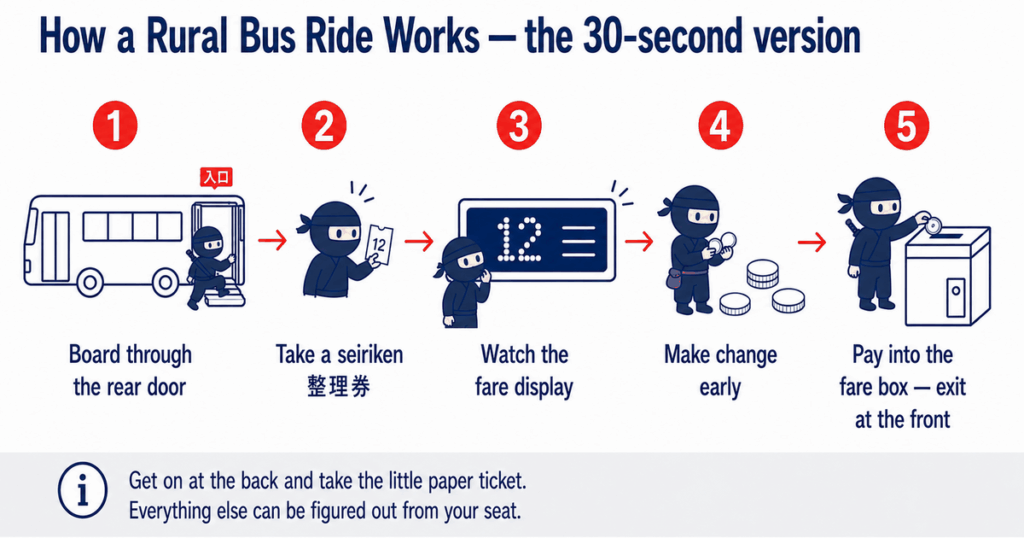
Two footnotes from riding these lines on individual tickets: on your own ticket, the Nozomi is simply available — no supplement, no slower-train compromise; Tokyo to Osaka, you board the fastest thing running and that’s the end of the decision. The further west your trip reaches, the more that freedom is worth — the same westbound logic from the Hiroshima pattern above, seen from the other side of the fence. And for everything that isn’t a bullet train — city subways, local loops, the buses that take over where rail thins out — a transit IC card plus cash covers you; the rural bus guide covers that layer of Japan in full.
Totaling your route on the official tools takes five minutes. It’s the same five minutes that decides the pass question honestly — which is why “run your total” has been the refrain of this entire page.
How to buy and activate (for the buying side)
You’ve sorted yourself onto the buying side and picked your pass. The mechanics, verified against the official pages:
Buying the nationwide pass. Two channels: the official online site (JAPAN RAIL PASS Reservation) or an overseas JR-designated sales office or agency, which issues an exchange order to swap in Japan — Klook (an authorized reseller) is one example of the latter. The October 2026 price note in the “What changed” section above is the reason to compare the two channels before paying — as of this writing, the announced revision text names the agency channel, so put the official online price and the reseller’s price side by side for your dates and let the numbers pick. Online payment on the official site is by credit card only, in the purchaser’s own name (official purchase page).
Picking it up. For online purchases: bring your purchase number and the passport holding your “Temporary Visitor” stamp or sticker to a JR-designated ticket office or a reserved-seat ticket machine. On timing, the official wording is that the pass “must be picked up before the start date or during the valid period” (official procedure) — collecting it before your start date is the version that doesn’t spend pass days on an errand. On where: I’ve seen the queues at the Midori no Madoguchi (JR ticket offices) at Narita and Haneda airports, and at Tokyo, Nagoya, and Osaka stations — at peak hours they are seriously long. The reserved-seat machines take a fraction of the time when your documents are in order.
Reserving seats. Buy online and you can reserve shinkansen and limited-express seats on the same official site before you arrive — the single best reason to use the online channel. Popular legs on popular dates sell out; reserve the trains you can’t afford to miss as soon as your dates firm up, and leave the flexible middle days unreserved.
Then do one more thing: give the pass a home. Here’s the observation this advice stands on: I’ve watched more than one traveler at a station stop dead, unloading pockets and daypack onto the floor, looking for a pass that was somewhere — a hotel desk, a train seat pocket, gone. A JR Pass is a paper product worth up to ¥140,000 that you’ll handle a dozen times a day for one, two, or three weeks, alongside an exchange order and a fistful of seat reservations. The fix costs nothing: one case, one place. Any zipped pouch or passport wallet you already own works — nothing to buy specially — and if something you own hangs on a neck strap, use that one: a case that stays around your neck can’t be left on a seat, and my advice is to put it on in the morning and not take it off between trains. Pass, reservations, and passport together, always in that one place, returned there after every gate. And “every gate” is where the habit earns its keep, because the pass feeds through the automated ticket gates like an ordinary ticket and comes back out on the far side — take it back; the classic slip is walking on without it — then slide it straight into its case the moment you’re through, not three escalators later. The reason this deserves its own paragraph instead of a footnote is in the official conditions, quoted in the FAQ below: a lost pass is not a paperwork problem. It’s a gone problem.
One more time, because this section is where sales-flavored writing usually creeps in: Japan Moves sells none of this. Buy on the official site or through a JR-designated sales agent, yourself.
Quick answers
Can I ride the Nozomi or Mizuho on the nationwide pass?
Not on the pass alone. You need the [ONLY WITH JAPAN RAIL PASS] NOZOMI MIZUHO Ticket, sold only to pass holders, priced per section — Tokyo–Kyoto ¥4,960, Tokyo–Hiroshima ¥6,500, Hakata–Kagoshima-Chūō ¥5,150, same price for any seat class (official page, as of July 2026). It’s sold at reserved-seat ticket machines, ticket offices, and travel centers — the official page doesn’t list an online option, so budget a machine stop. Note these figures have already been revised once since the ticket launched in 2023, so check the current table. Without it, the Hikari, Kodama, and Sakura cover the same routes with more stops — workable east of Osaka, genuinely tough by the time you’re aiming for Okayama or Hiroshima (see the Hiroshima pattern above). My own habit is the honest footnote here: traveling on individual tickets, I usually choose the Nozomi between Tokyo and Osaka — that’s the gap this supplement exists to bridge.
Who can actually use the nationwide JR Pass?
Per the official conditions: a foreign national visiting Japan with “Temporary Visitor” entry status — the short-term tourism stamp. That’s also why you’re reading a pass guide by someone who can’t use one: I live here, which disqualifies me and, I’d argue, un-conflicts this page.
Does the pass cover subways and city buses?
No — and this catches people weekly. The pass covers JR: JR trains including shinkansen (minus Nozomi/Mizuho), local JR bus routes, the Tokyo Monorail, and a few designated connecting lines. It does not cover private railways, city subways, or non-JR buses (official conditions). In practice: a transit IC card for cities, the pass for the long hauls — and for the countryside buses beyond both, the rural bus guide.
Is the Green Car pass worth the difference?
The 7-day Green pass is ¥70,000 against ¥50,000 ordinary — 40% more (official prices). My split: if your trip is built around many long rail days — the traverse pattern — the wider seat and quieter car are a real quality-of-life purchase, and if you have the budget, this is what spending it well looks like. If your rail time is a few two-to-three-hour hops, ordinary cars on the shinkansen are already comfortable, and ¥20,000 buys a lot of dinner. One catch from the official terms: Green-pass holders still pay the same NOZOMI MIZUHO Ticket prices — the supplement doesn’t get cheaper because the pass got dearer.
Is there a children’s pass?
Yes — half the adult price for ages 6–11 (official price page). A useful official detail for online purchases: the age that counts is the age on the payment date, so a child who is 11 when you buy still gets the child price even if a birthday lands mid-trip.
Can I start the pass partway through my trip?
Yes, and you usually should. You choose the start date when you buy or exchange, and pick the pass up before that date — the official wording allows pickup “before the start date or during the valid period” (purchase procedure). Spend your Tokyo days on an IC card, and start the clock the morning the long-distance travel begins. Decide carefully, though: per the official conditions, once the pass is issued its period of use cannot be changed.
The train I wanted is sold out. Doesn’t the pass cover it?
A pass is not a seat. Reserved seats are a finite allocation, and holidays eat them — reserve early (online, before arrival, if you bought online). Non-reserved cars remain an option on most trains, standing if it comes to that — but note the peak-season reserved-only operation of Nozomi trains mentioned above. If the sold-out train in question is the Sunrise Izumo night train to the San’in coast, that’s a special case with its own rules — covered in the San’in access guide.
What happens if I lose my pass?
The official answer is blunt: “the PASS cannot be reissued in the event that it is lost or stolen” (official conditions). No replacement, and from that point you’re buying regular tickets. That single sentence is why the one-case-one-place habit in the section above is the first thing I’d set up after purchase — before the first train, not after the first scare.
Five minutes of sorting, then forget the pass
The sorting is done, or five minutes from done. Whichever side you landed on, the pass — or its absence — is a tool, not a goal; decide, then put the decision away and go back to building the trip itself.
Before you book anything, the pocket checklist:
- Which side am I on? One regional block, a long traverse, or one clean corridor — the flowchart at the top settles it.
- Buying side: which pass, from the operator’s current official list, at this month’s price. Will I use Nozomi or Mizuho legs, and did I count the supplement? Which purchase channel is cheaper for my dates (an October 2026 question now)? Seats reserved for the can’t-miss trains? And the pass case — one case, one place.
- Skipping side: did I total my actual legs on the official tools? Smart EX set up and my card confirmed, before departure? IC card plan for the cities?
If your route runs west toward the San’in coast, the companion piece walks every access option: How to Get to Tottori & Shimane: A Complete Guide to Japan’s San’in Region. And for the layer of Japan no rail pass reaches, start with How to Ride Rural Buses in Japan.
Japan Moves currently provides editorial travel guides and general information. Paid individual route consultation is being prepared for a future phase.
Official sources referenced in this guide
- JAPAN RAIL PASS — Types and prices
- JAPAN RAIL PASS — Conditions for use
- JAPAN RAIL PASS — Use of NOZOMI/MIZUHO trains
- JAPAN RAIL PASS — How to purchase (online)
- JR Group — Date of the Revised Prices of the JAPAN RAIL PASS (July 2023, PDF)
- JR West — press release on the October 2026 revision (April 2026) / JR East PDF
- JR West — Rail pass lineup (English) / Hokuriku Arch Pass
- JR East — Passes (English)
- Smart EX — official English site / fare overview
- JR Central — Shinkansen online booking (English)
Japan Moves is an independent travel media project. It has no official partnership with any JR Group company, railway, bus operator, or airline. Some links on this page are affiliate links, as disclosed at the top of this article.