By Wataru Tanaka
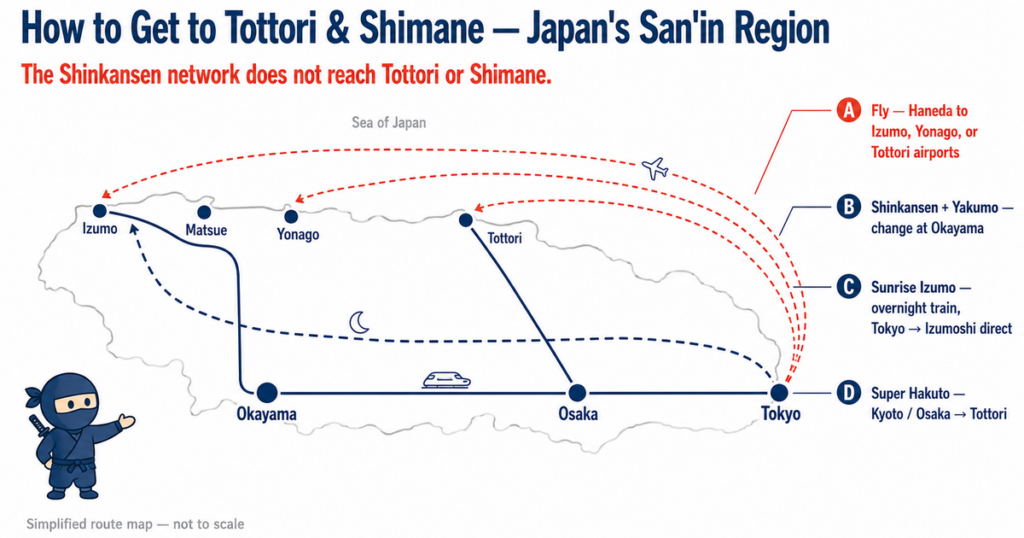
The Shinkansen network does not reach Tottori or Shimane — which means that in this corner of Japan, “how do I get there” isn’t a detail you sort out last. It is the itinerary. From Tokyo you have three options plus one (flights into three different airports, a Shinkansen-plus-express combination, the Sunrise Izumo overnight train — plus an overnight bus as the budget lane); from Osaka and Kyoto you have three more. This guide compares all of them — and, because the Sunrise sells out fast, it also gives you a backup plan that still gets you there. I haven’t padded it with anything I couldn’t verify: everything below is built from official timetables and operator pages, checked one by one.
This article may contain affiliate links. If you book or buy through these links, Japan Moves may receive a small commission at no additional cost to you. Japan Moves does not act as your travel agent or booking intermediary through these links.
Fares, timetables, and flight schedules verified as of July 2026. Always confirm current details on the official pages linked below.
If you’re deciding right now: flying is the fastest way from Tokyo for most trips — direct flights serve all three of the region’s airports. If you’d rather stay on rails, take the Shinkansen to Okayama and change to the Yakumo limited express. And the Sunrise Izumo? It’s something you try for, not something you bet the itinerary on. If you get it, it’s the best way into Izumo there is. If you don’t, this guide has you covered.
Where is San’in? (And why getting there takes planning)
San’in is the northern, Sea-of-Japan side of western Japan — in this guide, Tottori and Shimane prefectures, following the naming used by the region’s official tourism website. It’s a long, east–west strip of coast holding some of the country’s most storied places: Izumo Taisha, one of Japan’s oldest and most important shrines; the castle town of Matsue; the Tottori Sand Dunes; the silver-mine town of Iwami Ginzan.
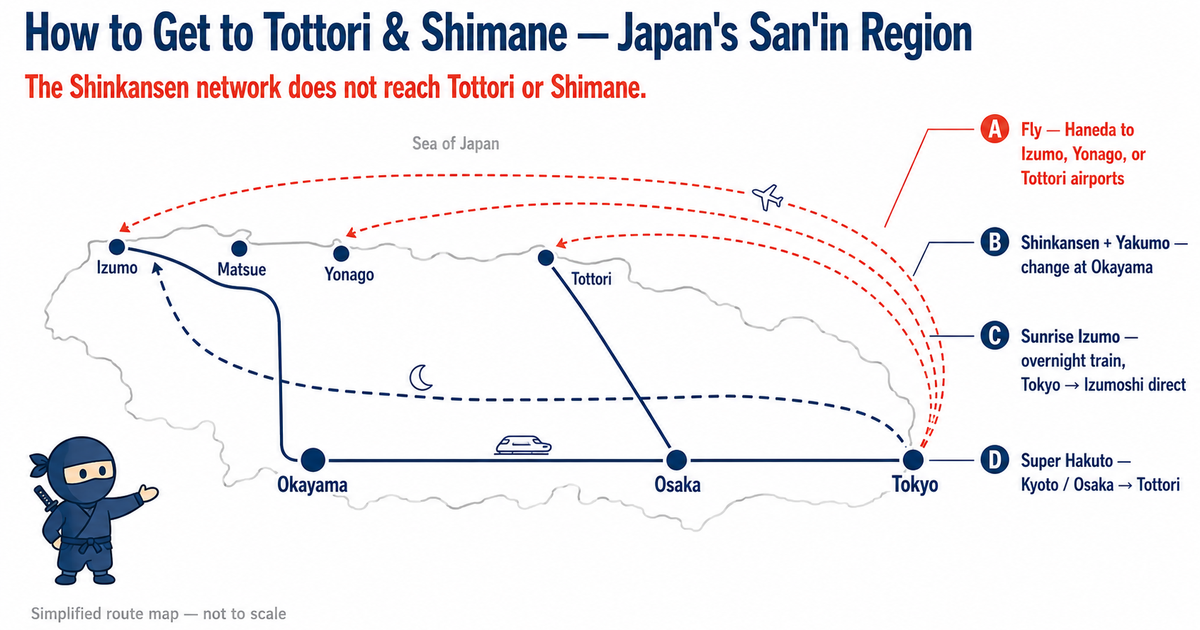
Here’s the structural fact that shapes every plan: the bullet train runs along the southern coast of western Japan, through Okayama and Hiroshima. To reach San’in, you cross the mountains. In practice that means two gateways, per the Japan National Tourism Organization’s own routing: for Matsue and Izumo, Okayama Station is the main transport hub, where you change from the Shinkansen to the Yakumo limited express; for Tottori city, you leave the Shinkansen at Himeji and change to the Super Hakuto limited express — a train that starts back in Kyoto and Osaka, so Kansai travelers don’t need the Shinkansen at all.
One reframe before the tables, because it matters for how you’ll feel about the extra planning: the absence of a trunk line is not a defect. It’s the exact reason Izumo Taisha at opening time feels nothing like the golden-route crush of Kyoto’s famous sites. The region isn’t hard to reach — it just has no single fat artery. It has several thinner ones, and thinner arteries reward the traveler who compares them. That’s what the rest of this page is for.
From Tokyo: how to get to Tottori, Matsue, and Izumo
Tokyo gives you three realistic options, plus one for the budget-minded. The table first, the judgment after.
| Option | Time (planning figure) | Cost character | How often | Best for |
|---|---|---|---|---|
| Fly — Haneda to Izumo, Yonago, or Tottori airports | ~1.5 hr in the air; figure ~4 hr door to door with airport time | Varies widely with how far ahead you book — from reasonable to painful | Multiple flights daily on each route — check each airport’s timetable | Time-first travelers; anyone starting the trip in San’in |
| Shinkansen + Yakumo — Tokyo → Okayama → Matsue / Izumoshi | ~3 hr to Okayama + ~2.5–3 hr on the Yakumo; figure 6.5–7 hr station to station | Fixed walk-up fare; no booking-timing games | Yakumo runs 15 round trips a day, roughly hourly | Rail-pass itineraries; anyone combining San’in with Okayama or Hiroshima |
| Sunrise Izumo — overnight train, Tokyo → Izumoshi direct | Dep. Tokyo 21:26, arr. Izumoshi 10:00 — the night is the journey | Base fare + express fee + a berth charge that depends on room type | One scheduled departure per night each way | Travelers who want the ride itself — and who read the next section first |
| Overnight bus (Susanoo) — Tokyo → Yonago / Matsue / Izumo | Dep. Tokyo 20:00, arr. Matsue 7:20, Izumoshi 8:15, Izumo Taisha 8:40 — figure ~12.5 hr | ¥5,500–¥16,000 one way, varying by date and seat type | One departure per night each way | Budget-first travelers who can genuinely sleep in a seat |
Sources for the numbers: flight time from Izumo Airport’s official schedule page (about 1 hr 25–30 min to/from Haneda); Yakumo frequency and times from JR West’s official Yakumo timetable (effective March 14, 2026); Sunrise times from the official Sunrise timetable; overnight bus times, fares, and operator from the official Susanoo timetable (JR Bus Chugoku). The Tokyo–Okayama Shinkansen leg and the door-to-door totals are my planning figures on top of those official numbers — confirm exact schedules on JR Central’s official timetable page when you book, and build in your own margins.
How to choose:
- If time is the priority, fly. Even with airport procedures on both ends, you’re in Matsue or Izumo by lunch on a morning flight. The rail route can’t match that from Tokyo, and there’s no schedule where it does.
- If you’re on a rail-pass itinerary, take the Okayama route — whether your particular pass actually earns its keep on this leg is exactly the kind of judgment we built our JR Pass decision guide for. The Yakumo’s roughly-hourly rhythm also makes this the most flexible option: miss one, catch the next.
- If you want to trade a night’s hotel for a night in motion and wake up rolling toward Izumo, aim for the Sunrise — but read the next section before you build anything on top of it.
- And the overnight bus exists as the cheapest way in — with real trade-offs. The Susanoo leaves Tokyo Station at 20:00 and reaches Matsue at 7:20, Izumoshi at 8:15: roughly twelve and a half hours overnight in a reclining seat, not a bed. Treat that as a physical commitment. If you don’t sleep well sitting up, the fare you saved tends to come out of your first day’s sightseeing; if you know you can, it’s a workable lane. Booking, like everything else on this page, is something you do yourself through the operator’s official channels. Note it serves the Matsue–Izumo side, not Tottori city.
Which airport, by the way, depends on your first destination, not on the airport’s name. That’s covered in the airports section below.
The Sunrise Izumo: how to book it — and what to do when you can’t
Let’s give the famous train its due first. The Sunrise Izumo — together with its twin, the Sunrise Seto — is Japan’s last regularly scheduled sleeper train, and it does something no flight can: you board at Tokyo Station at 21:26, sleep in an actual berth, and arrive at Izumoshi at 10:00 the next morning with the Shinji lakeshore sliding past your window in the morning light (official timetable). Returning, it leaves Izumoshi at 18:57 and reaches Tokyo at 7:08. The two trains run coupled as far as Okayama, where the halves separate — so when you board, make sure you’re in the Izumo half.
The catch is equally famous: demand for the private rooms routinely outruns supply, especially on weekends and holidays. So here is the booking reality, and then — more importantly — what to do when the answer is no.
The booking rules, from the official sources:
- Tickets go on sale one month before the travel date, at 10:00 a.m. Japan time. This is JR West’s stated rule for reserved tickets: reservations are accepted “up to one month before boarding (starting at 10:00 am (JST) on same day of preceding month)” (JR West official). For popular Sunrise dates, that 10:00 window is the whole game.
- Where to book: JR West runs a dedicated online booking page for the Sunrise through its e5489 reservation system, and any staffed JR ticket office (Midori no Madoguchi) can sell the same inventory. You book it yourself, directly with the railway — no agent required, and this site doesn’t take bookings for anyone.
- The rooms: all accommodation is private except one option — Single, Solo, Single Twin, Sunrise Twin, and Single Deluxe rooms, plus the Nobinobi seat, an open carpeted platform section that is officially classed as an ordinary car, not a berth (official equipment guide). Berth charges come on top of the base fare and express fee; the current amounts are shown at booking. The Nobinobi section’s ordinary-car status is also why it interacts differently with rail passes — the judgment framework for that lives in the JR Pass guide, and the current conditions are always worth confirming on the official pass pages before you plan around them.
- If you can’t complete the online booking from abroad, a JR ticket office on arrival in Japan can sell any date still available — though for peak dates, “still available” is doing a lot of work in that sentence.
Now the part nobody writes: the plan for when you don’t get it.
My position, plainly: the Sunrise is something you aim for, not something you bet the itinerary on. The travelers who end up stranded aren’t the ones who missed the ticket — they’re the ones who had no second route into the region and built three hotel bookings on top of a train they didn’t hold yet. So before the booking window even opens, know your fallback. There are three, depending on what the Sunrise was doing for you:
- Plan B-1 — you wanted the night to do the traveling. Take a late Shinkansen to Okayama, sleep there, and board a morning Yakumo. The first Yakumo leaves Okayama at 7:05 and has you in Matsue by 9:50, Izumoshi by 10:18 (official timetable) — within half an hour of what the Sunrise would have delivered, in exchange for one business-hotel night.
- Plan B-2 — you wanted to arrive in the morning. A morning flight from Haneda lands you in the region before the Sunrise would have arrived. Check the current morning departures on the airports’ schedule pages — Izumo’s shows flights landing by mid-morning.
- Plan B-3 — the rooms are gone but the train isn’t. Check the Nobinobi section (or the reverse: if the open section is full, check the rooms). Different inventory, same train, same window at dawn.
And the frame that ties it together: check your Plan B’s availability and booking deadline first, then go after the Sunrise. When you know exactly what happens if the answer is no, you can sit at the booking screen at 10:00 with no anxiety at all. If you get it — wonderful, cancel nothing but a tentative plan. If you don’t, you already know tonight’s alternative. Either way, you arrive.
One note for clarity: booking is something you do yourself, directly through JR’s official channels.
From Osaka and Kyoto: how to get to Tottori and Matsue
Kansai flips the logic. Tottori — a long haul from Tokyo — becomes the easy one, and the Shinkansen becomes optional.
| Option | Time (planning figure) | Cost character | Best for |
|---|---|---|---|
| Super Hakuto — Kyoto / Osaka → Tottori, Kurayoshi | ~2.5 hr Osaka → Tottori | Through-fare including the third-sector Chizu Express section | Eastern San’in (Tottori city, the dunes); the no-transfer option |
| Shinkansen + Yakumo — Shin-Osaka → Okayama → Matsue / Izumoshi | Short Shinkansen hop + ~2.5–3 hr Yakumo; figure ~4 hr | Higher, but pass-friendly (see below) | Western San’in (Matsue, Izumo) |
| Highway bus — Osaka → Tottori / Yonago (and services toward Matsue / Izumo) | 3–4 hr per JNTO for the Tottori/Yonago routes | The budget lane — but decide on the time trade, not the price alone | Travelers whose day the bus schedule happens to fit |
Sources: Osaka–Tottori time from the regional tourism site’s access page; the Himeji connection and ~90-minute Himeji–Tottori figure from JNTO; bus durations from the same JNTO page, with Osaka services toward Matsue and Izumo listed on the regional access page; Super Hakuto route and stations from Chizu Express, the line’s operator. The combined Shinkansen-plus-Yakumo total (~4 hr) is my planning figure on top of those official numbers — confirm exact schedules when you book, and build in your own margins.
The clean decision split: headed to Tottori and the east, the Super Hakuto is close to an automatic choice — direct from Kyoto and Osaka stations, no transfer, through scenery the Shinkansen never sees. Headed to Matsue or Izumo in the west, go via Okayama. The one wrinkle worth knowing on the Super Hakuto: its shortcut through the mountains, the Chizu Express line, is a separate “third-sector” railway rather than a JR line. On a normal through-ticket you’ll never notice. On a rail pass, lines like this are exactly where coverage questions live — the pass guide handles that judgment, and the pass section below names one pass that explicitly covers this train.
On the bus: I won’t sell it to you as a hack, because it isn’t one. It’s a straightforward trade — roughly an extra hour-plus of travel time against a lower fare. If the schedule fits your day, it’s a perfectly sound choice; the operators and current timetables are linked from the regional access page.
Changing at Okayama: the Yakumo in practice
Whether you started in Tokyo or Osaka, if you’re going to Matsue or Izumo by rail, you’ll stand on a platform in Okayama at some point. This is the region’s true rail gateway — many ways in, but from Okayama westward everything funnels into one train. So here’s the Yakumo in one paragraph.
It runs 15 round trips a day, roughly hourly (most departures at :13 past the hour, first train 7:05, last 21:20), taking about 2 hours 35–45 minutes to Matsue and about 3 hours to Izumoshi, calling at Kurashiki, Yonago, and Matsue along the way — all per the official timetable effective March 2026. The transfer at Okayama is an ordinary same-station change; if it’s your first time, give yourself fifteen or twenty minutes rather than sprinting for a tight connection, and note that limited expresses in this region can run fully reserved — sort your seat out when you buy your ticket, not on the platform. In peak seasons (Golden Week, Obon, New Year), book the Yakumo seat when you book the Shinkansen, the same way you’d never leave the second flight of a connection unbooked.
The ride itself, for what it’s worth, is the reason some travelers choose this route on purpose: the train threads the mountains on the Hakubi line and comes down to the Shinji lakeshore at the end. You give up speed against flying; you don’t give up much else.
Flying in: Izumo, Yonago, and Tottori airports
Three airports serve the region, all with direct flights from Tokyo Haneda, and they split the map neatly. Pick by your first destination, not by the name:
| Airport | Serves | Airport bus (the last mile) |
|---|---|---|
| Izumo Airport (Izumo Enmusubi Airport) | Izumo Taisha, Izumo city, western Matsue side | To Izumoshi Station, and to Matsue — ~35 min / ¥1,300 to JR Matsue Station, ~45 min / ¥1,400 to Matsue Shinjiko Onsen (operator’s official page); Izumoshi Station times and fares on the operator’s page |
| Yonago Airport (Yonago Kitaro Airport) | Yonago, Sakaiminato, eastern Matsue side | ~25 min / ¥640 to Yonago Station; ~45 min / ¥1,200 to Matsue Station (airport official) |
| Tottori Airport (Tottori Sand Dunes Conan Airport) | Tottori city, the Sand Dunes | ~20 min to Tottori Station (airport official), ¥480 (official fare sheet) |
Flight existence and times per each airport’s official schedule pages: Izumo (about 1 hr 25–30 min to/from Haneda), Yonago, Tottori. Each route has multiple flights a day; exact counts shift with the season, so check the airport’s current timetable rather than any blog’s — including, in principle, this one. That’s why the verification date is at the top.
The decision rule: Izumo Taisha first, fly to Izumo. Matsue or Sakaiminato, fly to Yonago. The dunes, fly to Tottori. Matsue sits within reach of both Izumo and Yonago airports — between those two, let the flight times decide, not the map.
Two pieces of practical knowledge that save actual pain:
- The airport buses are timed to flights, not to a fixed timetable. The Izumo airport buses explicitly wait for the arriving flight’s baggage delivery before departing (operator’s note) — good news when your flight runs late. The other side of that coin, per Yonago Airport: if the flight is cancelled, the bus may not run either. The bus exists for the flight.
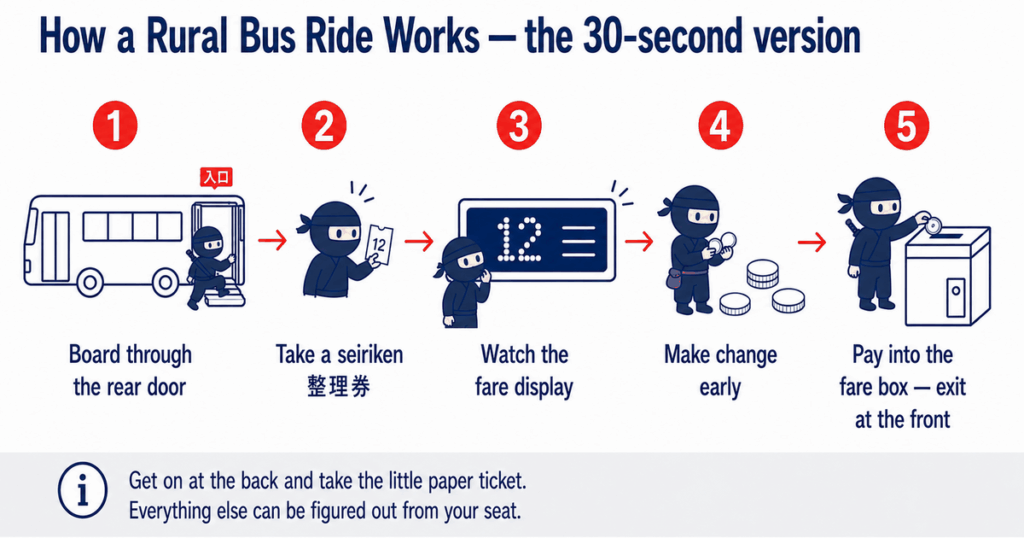
- Check the current month’s timetable on the airport’s official page, always. Airport bus schedules are rebuilt around each season’s flight schedule. The full technique for reading and planning around Japanese airport and rural buses — numbered tickets, exact change, the “read the last departure first” rule — is its own complete guide: How to Ride Rural Buses in Japan.
(One line for completeness: Shimane’s far west — the Iwami coast and Tsuwano — has its own airport, Hagi-Iwami, with direct flights from Haneda (official schedule). It sits outside this guide’s core route; if the far west is your goal, start from that page.)
Getting around Tottori and Shimane once you’re there
The region’s internal geography is one long east–west line: Izumo — Matsue — Yonago — Tottori, strung along the San’in main line, with the sights hanging off that spine. Three layers of transport run along and off it:
The rail spine. Between Izumoshi and Matsue you’re looking at roughly 25–30 minutes, Matsue to Yonago another 25 — short, frequent-enough hops (times from the Yakumo’s official timetable; local trains take longer). East of Yonago toward Tottori, treat it as a proper intercity leg on the San’in line’s own limited expresses such as the Super Matsukaze — not a quick side trip. The two prefectures read as neighbors on a map; on a timetable, crossing between their capitals is a half-day commitment round trip. Whether to attempt both in one trip is a days question — see the FAQ.
The Ichibata Electric Railway — the practical answer to “how do I actually reach Izumo Taisha.” This small private line runs from Matsue Shinjiko Onsen along the north shore of Lake Shinji to Izumo Taisha-mae, with a simple transfer at Kawato; it also connects from Dentetsu-Izumoshi, next to the JR station. Times and fares are on the railway’s official site, which has English pages. Riding a two-car local past the lake to Japan’s great shrine of connections is, fittingly, half the pilgrimage.
Local buses cover the rest: Matsue’s sights, the dunes from Tottori Station, and the “beyond the station” places — Iwami Ginzan is a bus ride from Odashi Station, and the dunes a bus from Tottori. This is exactly the territory where bus frequency, not distance, decides your day — some routes run a handful of times daily. The complete technique (boarding, paying, reading Japanese-only timetables, and building a day around three buses) is in the rural bus guide; this page won’t duplicate it.
One more branch worth knowing for the thin-frequency days: for some legs out here, the realistic option isn’t a scheduled bus at all but a pre-booked day tour or private transfer out of a hub city like Matsue or Tottori. Platforms like Klook list what actually operates from the region’s hubs — check availability and book directly yourself if the day’s timetable can’t carry you.
Passes worth considering: the Tottori–Matsue Pass and two wide-area JR West passes
Three passes in JR West’s official lineup cover this region as of July 2026:
- Tottori–Matsue Pass — ¥4,000 adult, 3 consecutive days, unlimited rides within the Tottori–Matsue zone including non-reserved seats on the area’s limited expresses (the official page names the Super Hakuto, Super Inaba, and Yakumo within the zone). Foreign-passport, temporary-visitor entrants only. This is the pass for moving around the region once you’ve arrived.
- Kansai–San’in Area Pass — ¥18,000 adult, 7 days, covering Kansai plus Tottori, Shimane, and Okayama, including the Sanyo Shinkansen between Shin-Osaka and Okayama and the Yakumo and Super Hakuto. The natural fit for a Kansai-plus-San’in loop — and note it explicitly covers the Super Hakuto, third-sector section and all.
- Sanyo–San’in Area Pass — ¥23,000 adult, 7 days, the wide-loop option adding Hiroshima, Yamaguchi, and the Sanyo Shinkansen through to Hakata.
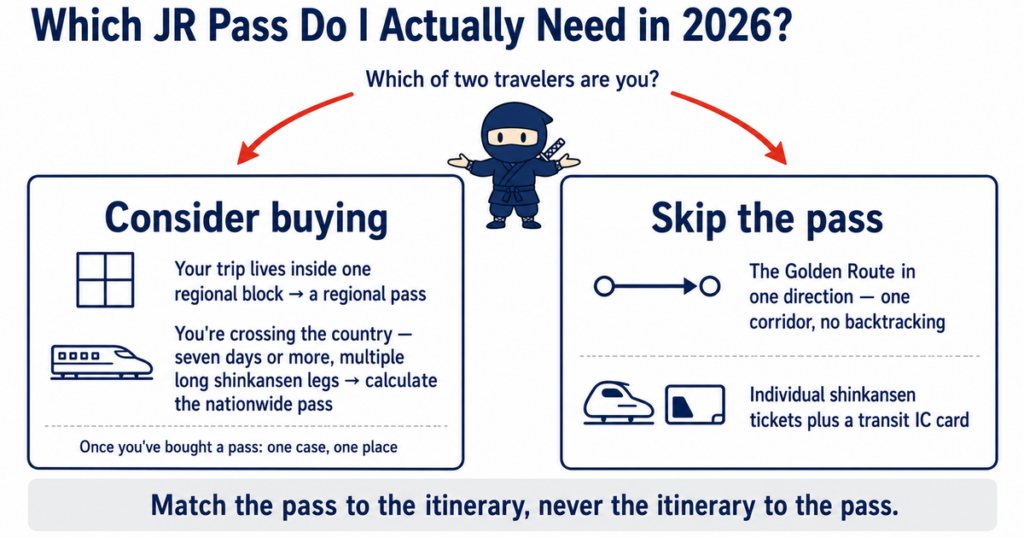
Whether any of these earns back its price on your itinerary is precisely the judgment this site keeps in one place: Which JR Pass Do I Actually Need in 2026? runs that decision in five minutes. Here I’ll only say: check conditions and buy on the official pages yourself. Japan Moves doesn’t sell passes and is not affiliated with any railway.
Where to stay
One paragraph, because lodging gets its own coverage later: as a base, Matsue or Izumo city is the practical choice for the west, Tottori city for the east. Matsue in particular sits at the hinge of the lake, the shrine line, and the rail spine, which is why most public-transport itineraries end up sleeping there at least once. How to choose the actual room — lakeside onsen versus station-front business hotel, and when each is worth it — is a separate judgment for a separate article.
Quick answers: the questions everyone asks
How many days do I need?
For Izumo Taisha plus Matsue at a humane pace: two nights. You can technically day-trip the shrine from Matsue in a morning, but you’d be trading away the early-morning shrine, which is the best version of it. Adding the Tottori side — the dunes, the crossing between prefectures — makes it three to four nights, because Matsue–Tottori is an intercity leg, not a hop. One prefecture done well beats two done through a train window; if your total Japan trip has only two spare nights, spend both of them on one side.
Can I do San’in without a car?
The route this guide is built around — Izumo, Matsue, Yonago, Sakaiminato, Tottori city, the dunes — works on public transport, and this page plus the rural bus guide is the toolkit for it. The honest boundary: once you leave that spine for rural coastline and mountain valleys, bus frequency thins fast, and some corners genuinely assume a car. The technique that decides whether a carless day works is always the same — find the buses first, then build the day around them, never the reverse.
What about winter?
Winter here means real snow, and the mountain crossing on the Yakumo’s route is the kind of terrain where heavy snowfall can delay or suspend trains — a general seasonal pattern, not a prediction for your dates. The practical preparation costs one bookmark: JR West’s official service-status page (Japanese-first, but the status icons are readable), checked on travel morning. I’d never argue against winter San’in — this coast in snow-crab season is a strong reason to come — just travel it with a flexible margin and the status page bookmarked.
Is the Sunrise Izumo worth it if I can also fly?
They’re not really competing products. The flight buys you time: door to door in a morning. The Sunrise is part of the trip: a night in a berth, morning light over the Shinji lakeshore, arrival at 10:00 having spent zero daylight hours in transit. Decide which one you’re buying — time, or the experience of the crossing itself — and either answer is correct. The only wrong version is betting a rigid itinerary on a sold-out train, which is what the Plan B section exists to prevent.
Before you book anything
The through-line of this whole page: where no single fat artery exists, the traveler who knows the options holds all the leverage. A four-item checklist before anything gets paid for:
- Chasing the Sunrise? Confirm your Plan B’s availability first, then sit down at the booking screen at 10:00 Japan time, one month out, calm.
- Flying? Check the current month’s airport-bus timetable on the airport’s official page — the bus schedule is rebuilt around each season’s flights.
- Winter trip? Bookmark the service-status page before you need it.
- Considering a pass? Run the five-minute judgment first — and once you’ve landed in the region, the rural bus guide takes over from this one.
Decide the route, and the distance stops being the story. San’in was never far — it just asks you to choose your door.
Japan Moves currently provides editorial travel guides and general information. Paid individual route consultation is being prepared for a future phase.
Official sources referenced in this guide
- JR West — Ticket reservation rules (English)
- JR Odekake Net — Sunrise Seto / Sunrise Izumo equipment guide (Japanese) / official timetable PDF / official booking page
- JR Odekake Net — Yakumo (Japanese) / timetable PDF effective 2026-03-14 / Super Matsukaze
- JR Central — Tokaido-Sanyo Shinkansen timetable (English)
- JR Bus Chugoku — Susanoo overnight bus timetable (Japanese, PDF)
- JNTO — Shimane / Tottori
- San’in regional tourism website — Access
- Chizu Express — Super Hakuto (Japanese)
- Izumo Airport — flight schedules (Japanese) / Yonago Airport / airport bus / Tottori Airport — access / fare sheet PDF / Hagi-Iwami Airport — flights
- Izumo Ichibata Kotsu — airport bus (Japanese) / Matsue Ichibata Kotsu — airport bus (Japanese)
- JR West — rail pass lineup / Tottori–Matsue Pass / Kansai–San’in Area Pass / Sanyo–San’in Area Pass
- Ichibata Electric Railway (Japanese, with English pages)
- JR West — train service status (Japanese)
Japan Moves is an independent travel media project. It is not affiliated with any railway, airline, bus operator, or transport association.