By Wataru Tanaka
Even Japanese travelers hesitate the first time they board a bus in an unfamiliar region — I do too. That’s because the rules belong to each bus operator, not to Japan as a whole: the routine you learned in Tokyo can quietly stop working one prefecture over. This guide puts the whole system in one place — the five steps of boarding, how to pay without holding up the line, how to read a Japanese-only timetable, and how to plan a day around a route that runs three buses a day — based on years of checking Japan’s transport on the ground, region by region.
This article may contain affiliate links. If you book or buy through these links, Japan Moves may receive a small commission at no additional cost to you. Japan Moves does not act as your travel agent or booking intermediary through these links.
Fares, timetables, and pass conditions verified as of July 2026. Always confirm current details on the official pages linked below.
The 30-second version: how a rural bus ride works
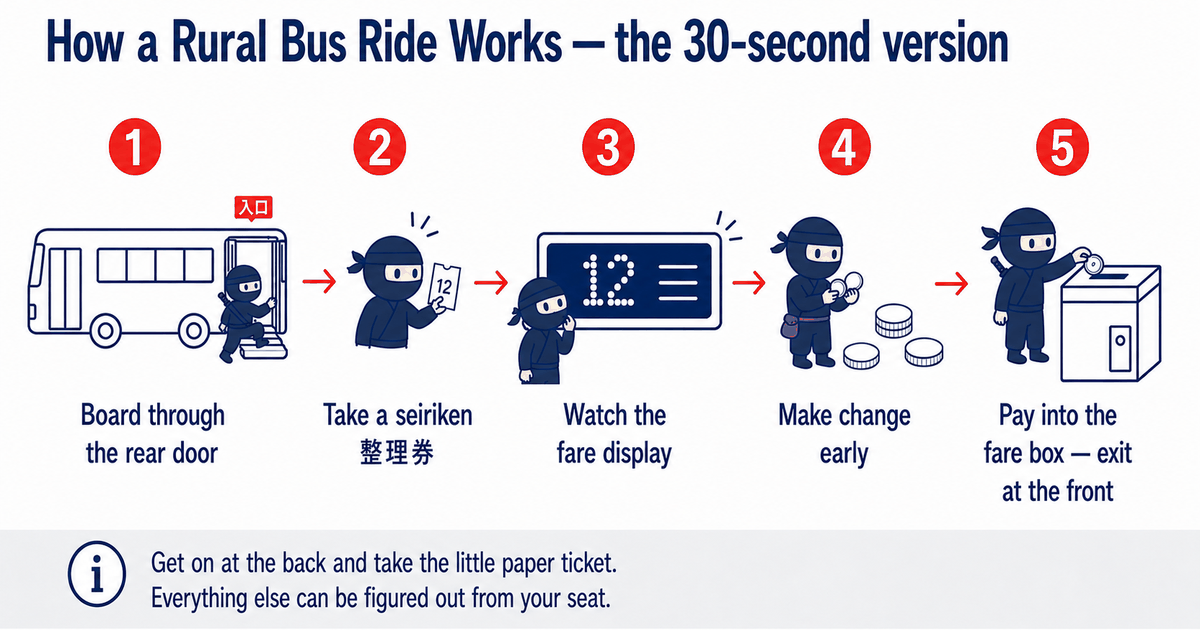
If you’re standing at the bus stop right now, here is the whole ritual:
- Board through the rear door. On most rural routes, the front door is the exit.
- Take a seiriken (整理券) — a small numbered paper slip — from the machine beside the door as you step on.
- Watch the fare display panel above the driver. Your fare is the amount shown under your seiriken number, and it changes as the bus moves.
- Make change early, at the change machine on the fare box, while the bus is stopped — not in the final seconds before your stop.
- Drop the seiriken and the exact fare into the fare box as you exit at the front, next to the driver.
Each step has its own section below, including what to do when something goes wrong. If you only remember one thing: get on at the back and take the little paper ticket. Everything else can be figured out from your seat.
This is the rear-boarding, pay-on-exit system, and it’s the one that trips up visitors — you can see the same sequence spelled out by operators themselves, for example in Nara Kotsu’s official English guide. The catch is that not every bus in Japan works this way, which is exactly where we start.
Which door do you board from? (And why the answer changes)
There are two systems running in parallel across Japan:
- Front-boarding, pay as you enter. Common where the fare is flat. You board at the front, pay immediately, exit at the rear. Central Tokyo’s buses work this way — a flat fare collected when you step on (japan-guide.com uses Tokyo as the standard example).
- Rear-boarding, pay as you exit. Common where the fare depends on distance. You board at the rear, take a seiriken, and pay at the front when you get off (Nara Kotsu’s guide documents both systems side by side).
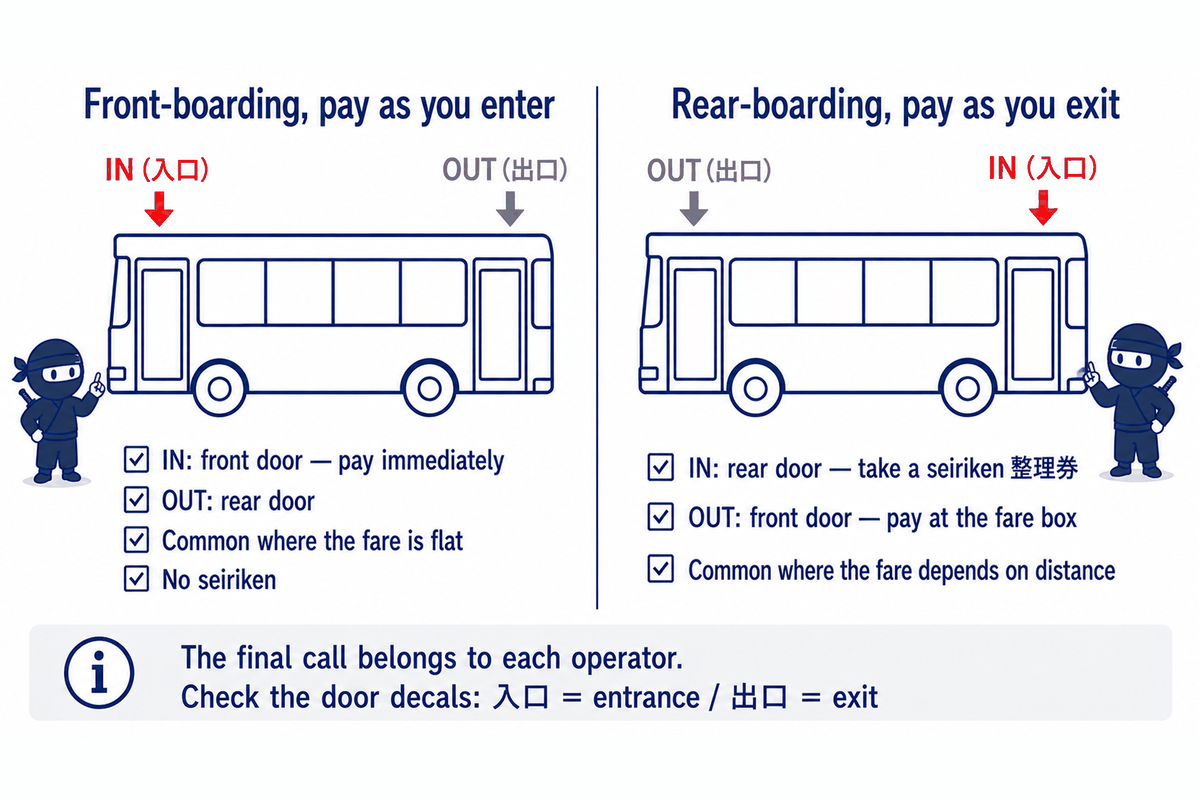
Here’s the logic underneath, because it makes the pattern easier to trust: a distance-based fare needs a record of where you got on. The seiriken is that record — so distance-based routes tend to pair with rear boarding. It’s a tendency, though, not a law. The final call belongs to each operator.
Kyoto proves the point. Kyoto City Bus charges a flat fare in its central zone — ¥230 for adults, ¥120 for children, per the official English fare page — yet you still board at the rear and pay when you get off, exactly as the city’s own how-to-ride page (Japanese) describes it. Flat fare, rear boarding. So much for the shortcut “flat fare means front door.” (Kyoto has, in fact, announced a decided plan to move its flat-fare routes to front-door boarding by the end of fiscal 2028 — March 2029 — which only strengthens the real lesson: these rules are operator decisions, and operators change them.)
So don’t memorize city-by-city rules. Run the three checks I use instead, in the ten seconds before the bus arrives:
- Where are the locals lining up? If the queue forms at the middle or rear door, that’s your door.
- What do the door decals say? Look for 入口 (entrance) and 出口 (exit) beside each door.
- Is there a seiriken machine just inside the door? If yes, take a ticket — you’re in the pay-on-exit system.
Observation beats memorization. That’s the single most transferable skill on Japanese buses.
The seiriken (整理券) system, step by step
The seiriken is the part of the system with no equivalent in most countries, so let me slow down here.
What it is: a small paper slip with a number printed on it, dispensed by a machine at the boarding door. The number is not a seat number and not a queue position — it identifies the stop where you boarded. It’s how a bus with a single crew member runs a distance-based fare system without anyone checking tickets: the slip is your boarding record, and you settle up once, at the end.
The sequence:
- Take it as you board. The machine is at hip height, just inside the rear door. One slip per person.
- Note your number. Say it’s 7. That 7 means “boarded at stop 7 on this route.”
- Find your number on the fare display panel at the front of the bus. Under each number is a yen amount, and that amount is what you’d pay if you got off right now. As the bus travels further, the amounts climb.
- When you get off, drop the seiriken and the fare shown under your number into the fare box next to the driver.
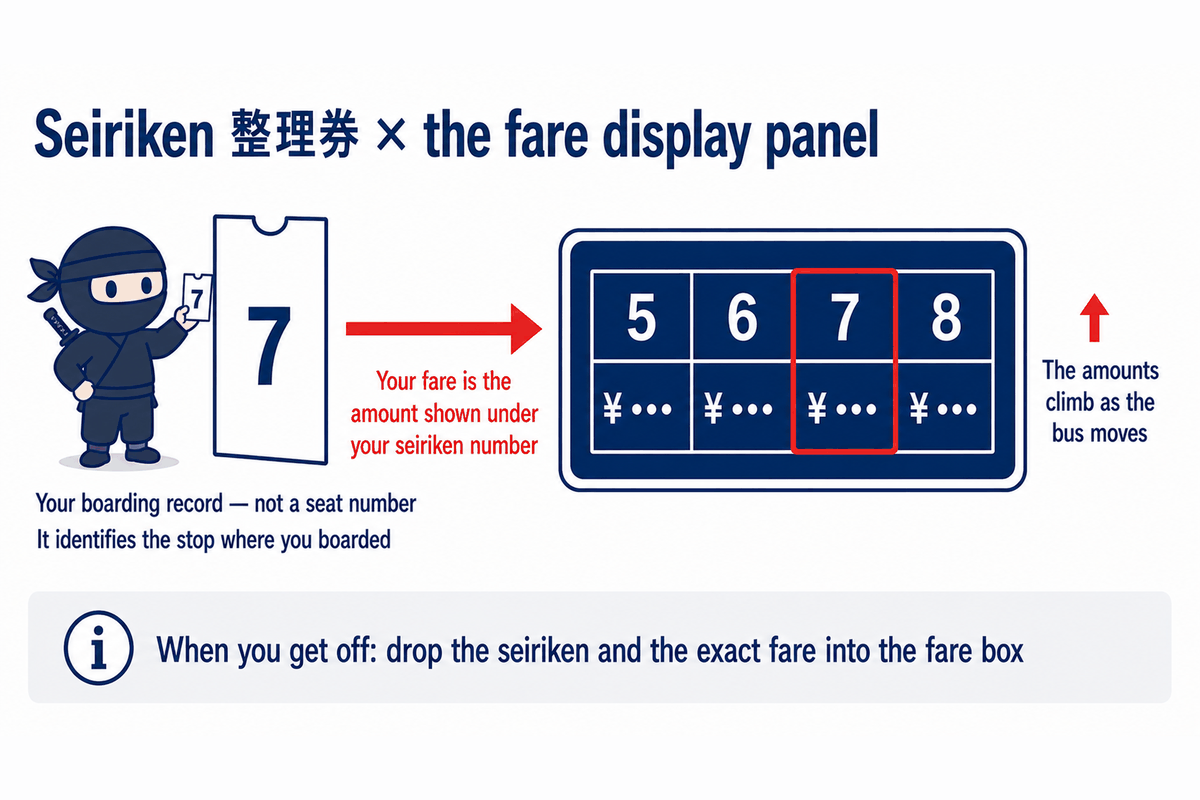
I put this exact sequence to the test in Okayama on the Okaden buses — the local network run by Okayama Electric Tramway. Board at the rear, take the slip, watch the panel, pay the driver-side box on the way out. It worked precisely as described, and that’s the useful news: the skeleton of the system is the same nationwide. Operators differ in details — which door, which fare structure — but once you’ve done the seiriken dance once, you’ve done it everywhere. The three checks from the previous section absorb the differences.
Here’s where people trip: taking the slip at all. I’ve watched more than one traveler step aboard with a suitcase in one hand and a phone in the other and walk straight past the machine. Nothing dramatic happens — there’s a fix, covered in the FAQ below — but the smoothest ride starts with a free hand at the door.
Paying at the fare box: exact change and the ¥1,000 rule
Riding around Okayama city, I spent more of the trip than I’d like to admit watching the fare display. Every few stops, the amount under my number ticked up — and every time it did, I caught myself digging through my coins again, recounting. That’s the honest texture of a distance-based bus: what you owe is a moving target until the moment you get off. Which is why the paying part deserves its own section.
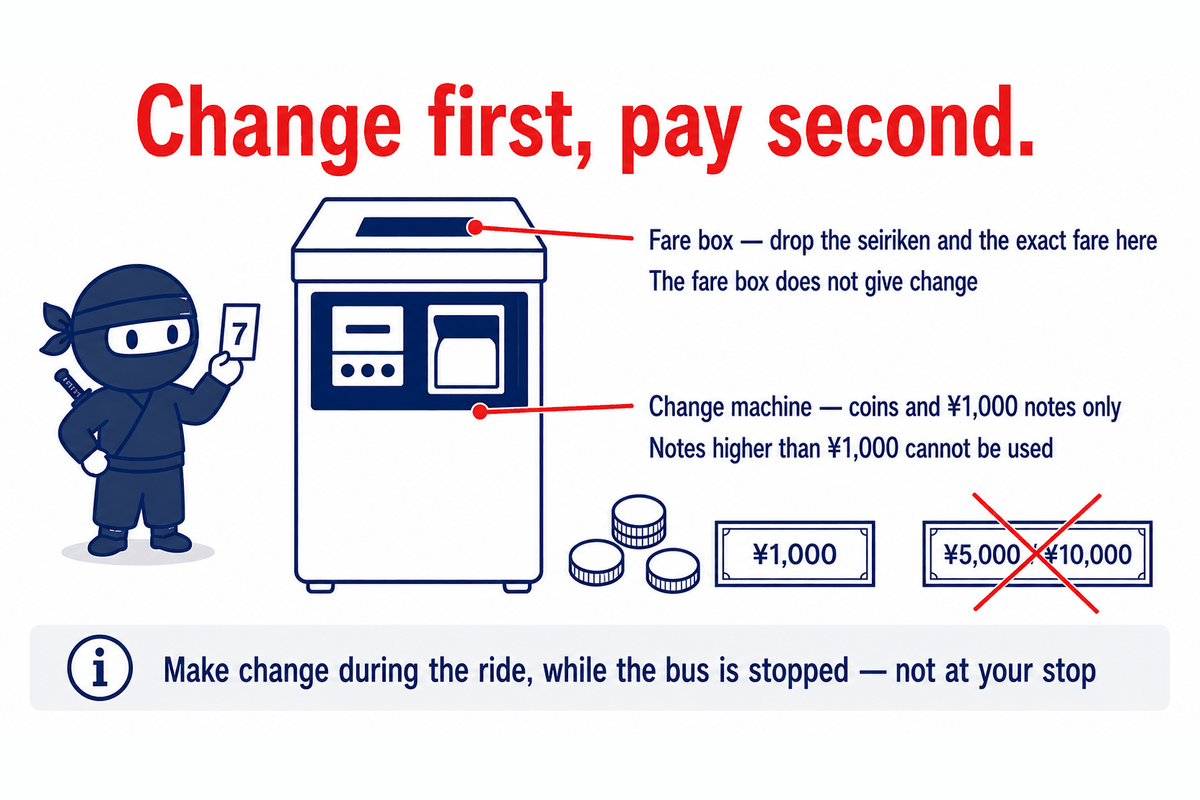
The core fact, and the one that catches almost everyone: the fare box does not give change. You pay the exact amount. Making change is a separate action, done at the change machine built into or next to the fare box — and per Nara Kotsu’s official English page, “notes higher than 1,000 yen cannot be used in the money changer.” Treat that limit as the rule on every bus you board in Japan — exceptions exist, but they’re not worth betting an evening on. A ¥5,000 or ¥10,000 note is not money here; it’s a problem.
So the sequence is: change first, pay second.
- Break your ¥1,000 note at the change machine during the ride, while the bus is stopped at a light or a bus stop — not while it’s moving, and not in the final scramble at your stop. There’s a small crowd dynamic at the front door when several people pay at once; the person fumbling for change with six people behind them is having a worse day than necessary.
- Better still, board with coins already in your pocket. Any convenience store will break a large note if you buy a bottle of tea.
My rule of thumb, and I’ll state it plainly: two ¥1,000 notes plus a handful of coins, and you will not get stuck on any bus in Japan. This isn’t a budgeting exercise — it’s preparation, the same way you’d carry a passport. The amounts involved are small; the problem was never the money, only the denomination.
Two footnotes worth having:
- Traveling with kids: children aged 6–12 typically ride for half fare, rounded up to the nearest ten yen — that’s the standard pattern, spelled out for example on Nara Kotsu’s fare rules.
- Fares change — distrust old blog posts. Okaden revised its sectional fares in October 2025: the stretch from Okayama Station to Tenmaya, for instance, went from ¥120 to ¥160. Any fare figure you find in a two-year-old article may simply be wrong. Check the operator’s current page.
One genuine relief: on routes with IC card readers, this whole coin choreography disappears — tap on, tap off. The Okaden buses I rode take cash and the regional Hareca IC card (official fare page). But whether your card — the Suica in your phone — works out here is a different question, and the answer is the next section.
IC cards on rural buses: where Suica stops working
In the big cities, one IC card feels universal, and that feeling has a real technical basis: ten major transit cards — Suica, PASMO, ICOCA, and their regional siblings — are mutually accepted across each other’s networks. PASMO’s official visitor page lays this out, and note the caveat it attaches: these cards “cannot be used on some lines, so make sure to talk to the train and bus operators.”
That caveat is where rural Japan lives. Three holes in the “one card, whole country” picture:
- Operators outside the network. Some regional bus companies never joined the nationwide scheme. They take cash, and sometimes their own local IC card — but not yours. English-language coverage has noted operators in parts of Kyushu, among other regions, that accept only a local card or cash (LIVE JAPAN). There is no reliable master list; assume nothing.
- Area boundaries on rail. This one bites on the train ride to the bus: JR East’s own English materials for its visitor Suica state the card works on IC-marked railways and buses nationwide but cannot be used for a journey that crosses from one IC area into another (JR East, Welcome Suica). Start and end within one area, or buy a paper ticket.
- Top-up reality. Don’t count on being able to charge your card once you’re on board or out in the countryside. Some buses have top-up capability; many don’t. If your balance is low when you leave the city, it’s low for the day.
My working conclusion for rural Japan: cash is the system; IC is a bonus when it appears. Researching whether Suica works on one specific rural route takes longer than breaking a ¥1,000 note — put the ten minutes into your itinerary instead.
How to read a rural bus timetable (when it’s only in Japanese)
Outside the cities, assume the timetable at the stop — and often the operator’s website — is Japanese only (digi-joho’s overview documents the pattern). The good news: a Japanese bus timetable contains exactly three words you need.
| On the timetable | Reading | Means |
|---|---|---|
| 平日 | heijitsu | Weekdays (Mon–Fri) |
| 土曜 / 土曜日 | doyō / doyōbi | Saturdays |
| 日祝 / 日曜・祝日 / 休日 | nichi-shuku / kyūjitsu | Sundays & national holidays |
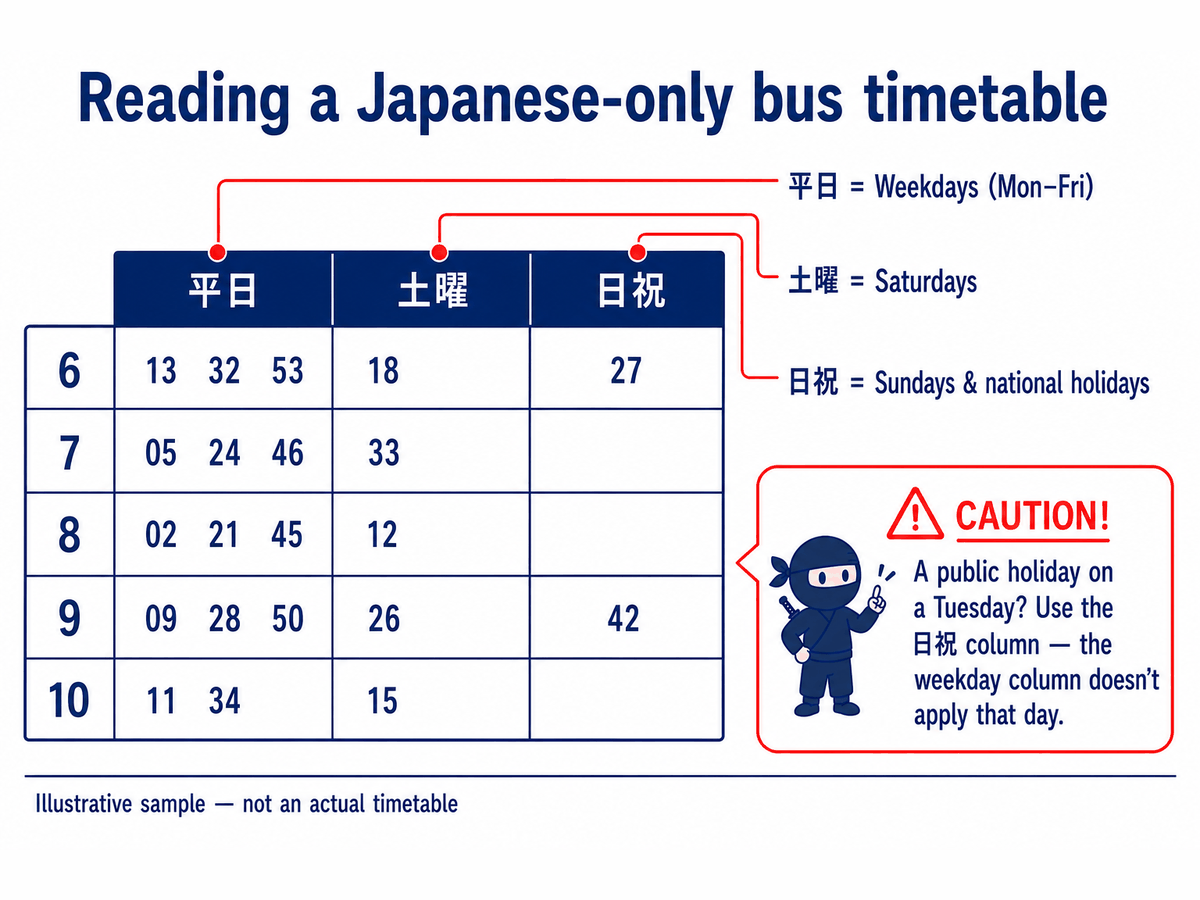
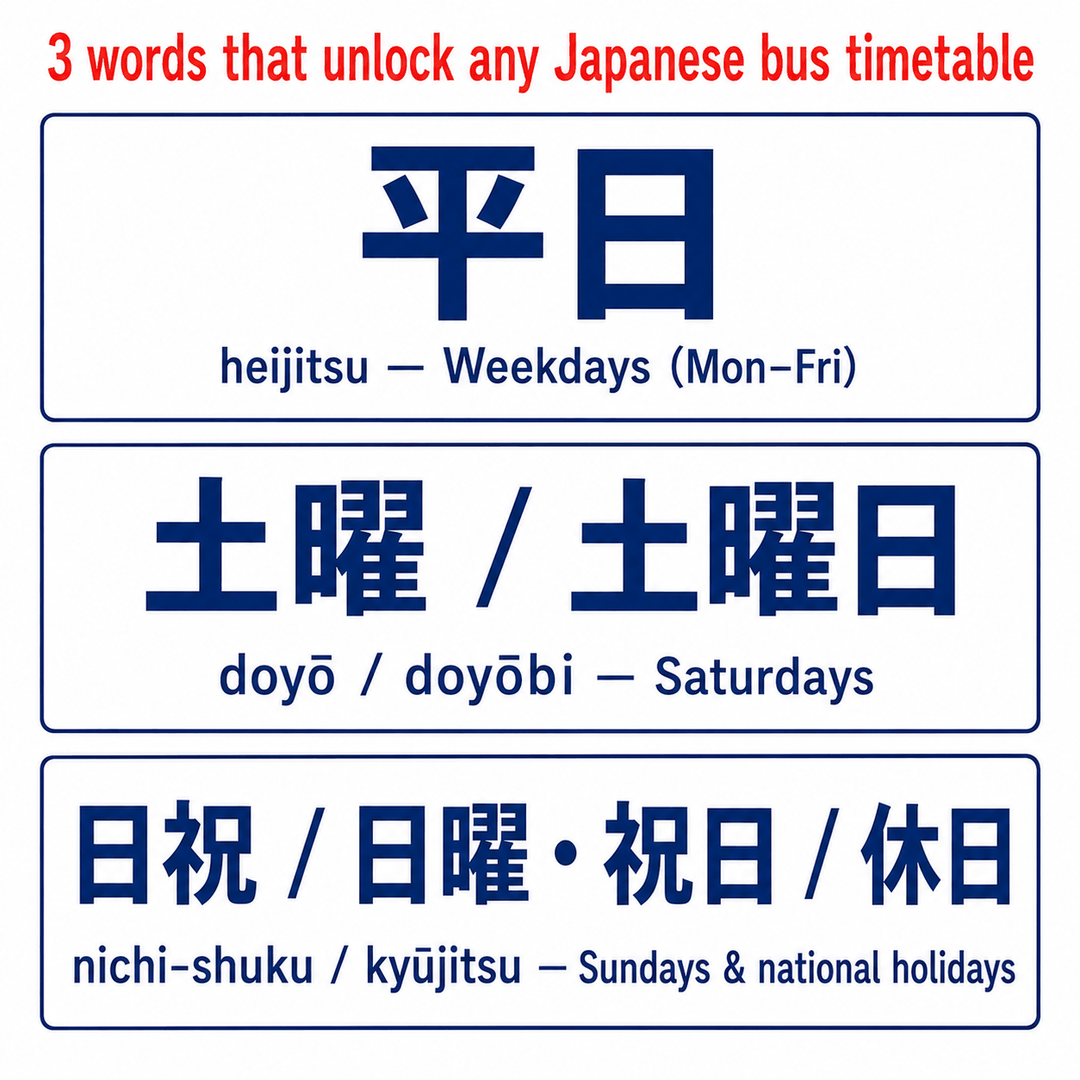
The classic mistake is reading the wrong column. Two traps inside it:
- National holidays follow the holiday column even when they fall on a weekday. If it’s a public holiday Tuesday, the 平日 column is a work of fiction for the day. When in doubt, check whether today is a Japanese public holiday before trusting the weekday column.
- Columns can differ a lot. On rural routes, the Sunday/holiday column is often dramatically thinner than the weekday one — sometimes to zero.
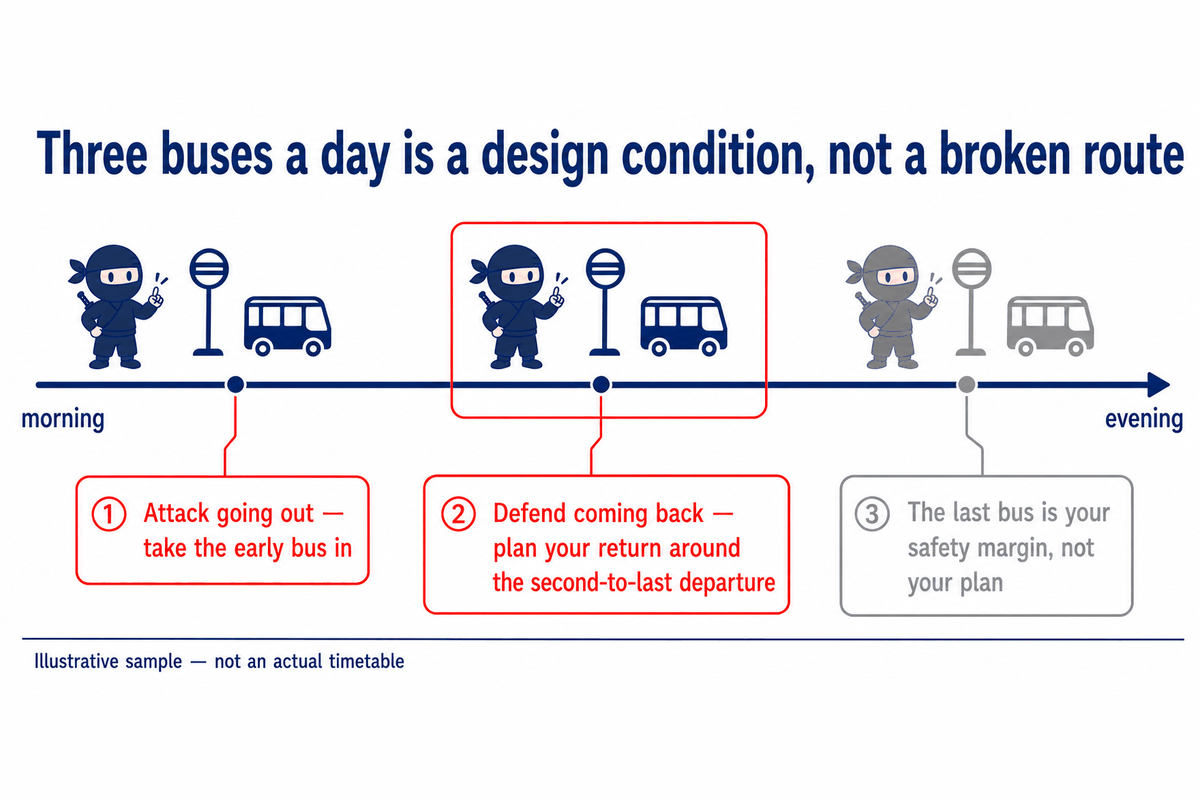
And here is the habit that matters more than any vocabulary: don’t read a timetable top to bottom. Read the last departure first. The worst failure on rural transport isn’t missing a morning bus — it’s discovering at 5 p.m. that the last bus back left at 4:40. Find the final departure, then the one before it, and build your day backwards from there. I learned the value of this the slow way, standing at an airport bus stop in Kagawa — that story next.
Planning around three buses a day
First, the reframe that makes everything else work: a route with three or five departures a day is not broken. Low frequency is a fixed condition of rural Japan, like weather. You don’t fix conditions; you design around them. Travelers who internalize this stop being victims of the timetable and start being editors of it.
Now the story. I flew into Takamatsu, in Kagawa, planning to catch an airport bus onward — the route toward Sakaide and Marugame. My flight landed late. The bus I’d aimed for was gone — it had left exactly on time — and the route ran about five departures a day back then. The next one: two hours away. Nobody did anything wrong. The flight was late, the bus was punctual, and my plan had zero slack. That two-hour lesson is the whole science of rural bus planning in one sitting: the attacking plan fails on the one variable you don’t control.
(For current details rather than my memory: Takamatsu Airport’s official access page lists five bus routes run by five different operators as of July 2026, with timetables posted month by month, matched to each month’s flight schedule. Which leads to a rule almost no English guide mentions: airport bus timetables are perishable — always check the current month’s version on the official page, not a screenshot from someone’s trip report.)
Out of that experience, three planning principles:
- Build the day around the bus, not the sights. In cities you pick sights and assume transport. Out here, invert it: find the two or three bus times that exist, then decide what fits between them. It sounds like a constraint; in practice it produces calmer, better days.
- Attack going out, defend coming back. Take the early bus in with ambition — but plan your return around the second-to-last departure, and know before you leave what happens if you miss it: when the truly last bus goes, what a taxi would cost in time, whether there’s a rail line covering part of the distance. My Takamatsu miss cost two hours because a next bus existed. Defense is knowing your next-best option before you need it.
- Two ways in, two ways out. The itinerary doesn’t have to be symmetrical: bus in, taxi back is a legitimate design, not a failure state. If you have the budget, a one-way taxi at the end of a long day is what spending it well looks like — you’re not paying for a car, you’re buying back the last two hours of daylight.
One more branch worth knowing: in some regions, the realistic option for a specific leg isn’t a scheduled bus at all but a pre-booked day tour or private transfer out of the nearest hub city. Platforms like Klook list what actually operates from regional hubs — check availability and book directly yourself if the day’s timetable can’t carry you. Same logic as the taxi: matching value to price, not rescuing a cheap plan with an expensive panic.
When Google Maps doesn’t know the bus exists
Google Maps is good in Japanese cities and merely okay in the countryside. Three failure patterns I keep running into:
- The route is missing entirely — common with small municipal buses.
- The times are stale — the route appears, but reflects a timetable one or two revisions old.
- The stop pin is off — the bus exists, the stop exists, but not quite where the map says.
The sentence to keep: “no route found” does not mean there is no bus. It means Google doesn’t have the data.
The recovery procedure, which takes five minutes:
- Search the town name plus コミュニティバス (community bus) — paste the kanji exactly. Example:
美作市 コミュニティバス. - That lands you on the municipality’s official page, almost always with a PDF timetable.
- Screenshot the PDF — rural Japan has dead zones, and the PDF that saved your afternoon is useless if it needs a signal.
Going straight to the operator’s or town hall’s own page is the ground truth; it’s the same move I made checking the Takamatsu routes. Maps apps are an index, not the library.
Community buses and on-demand transport
There’s a second layer of rural transport that never shows up in booking apps and only sometimes in Google Maps: the community bus (コミュニティバス) — small buses run or subsidized by the municipality itself, connecting train stations, clinics, town halls, and residential pockets. They’re designed for residents, but nothing stops a traveler from riding. Fares are set town by town, so check the amount on the municipal page you found with the search trick above.
Beyond that sits on-demand transport (デマンド交通): shared taxis or minibuses that run only when booked. Two practical realities: they usually require reservation by phone, and the phone line is frequently Japanese-only. The workable route for a visitor: if you’re staying at a local ryokan or guesthouse, asking the front desk to place the call for you is entirely normal — booking things by phone is something Japanese accommodations handle daily. You make the request; they dial. That small favor unlocks transport that officially “doesn’t exist” in any app.
Knowing this layer exists is most of the battle. In a lot of rural Japan, the timetable you can see is not the whole system.
Bus passes worth knowing (and what they don’t cover)
Let me say the important part first: the bus passes marketed to visitors cover intercity highway buses — not the local rural buses this guide is about. No pass currently on sale gets you onto the seiriken-and-fare-box buses of the countryside. With that framing:
- Willer’s Japan Bus Pass ended sales on September 30, 2025 (official notice). If an article recommends it, that article is stale — a good live test of any source’s freshness, this one included; hence the verification date at the top.
- JBL Pass (official page) — an unlimited-ride pass for express buses across a wide network. Conditions as of July 2026: foreign (non-Japanese) passport holders only; 3-, 5-, or 7-day versions, and the days don’t have to be consecutive, used within one month of purchase; up to 3 buses per day; sold only on the official website. Pricing isn’t posted on the public page — confirm it on the official site when you register.
- Shikoku Highway Bus Free Pass (official page) — covers seven express routes linking Shikoku’s main cities (Takamatsu, Matsuyama, Kochi, Tokushima). As of July 2026: 2 days ¥10,000, 3 days ¥11,000, 5 days ¥12,000, any days within one month; foreign passport holders only; website purchase only. Local route buses are explicitly not included.
The honest decision rule: if your itinerary is city-to-city hops — Matsuyama to Kochi to Takamatsu — a highway pass can earn its keep. If your itinerary is the deep countryside, these passes do nothing for you, and the local fares you’ll actually pay are small enough that “pass optimization” is the wrong problem to solve. Check availability and buy on the official sites yourself; Japan Moves is independent and not affiliated with any bus operator or association.
Quick answers: the situations that actually happen
These are the moments this page was written for — the ones I’ve watched unfold from a few seats back, more than once.
What if I lose my seiriken (or never took one)?
Tell the driver where you boarded — honestly, and before you’re standing at the fare box digging through pockets. Handling varies by operator, but stating your boarding stop is sometimes all that’s needed (Wikivoyage notes the same); the driver may well have a fair idea of where you boarded anyway. Don’t be tempted to name a closer stop to shave the fare — drivers know their route far better than you know your stop.
As for never taking one: I’ve watched more than one traveler board with luggage in both hands and sail straight past the seiriken machine. It’s the single most common miss in the whole system, and it’s common precisely because the machine is small and your hands are full. The prevention costs nothing — free hand, take the slip, pocket it. If it’s already happened, see paragraph one: honesty at the front door.
I don’t have exact change and the machine won’t take my ¥5,000 bill
Correct — it won’t. The change machine handles coins and ¥1,000 notes; anything larger is where plans die (Nara Kotsu spells it out). Two-part answer:
- Prevention: break big notes before boarding — any convenience store purchase does it — and carry the two-¥1,000-notes-plus-coins kit from the fare box section.
- In the moment: make change at the machine while the bus is stopped, well before your stop. I’ve seen the alternative play out — someone realizes mid-ride, stands up while the bus is moving, and lurches down the aisle to the change machine. It’s a common scene because the fare creeps up on you; the fix is simply doing your change run early, from a standstill. And if you’re truly stuck holding only a large note, speak to the driver before the queue forms behind you — how it’s resolved varies by operator, but the conversation goes better at a stop than at the box.
I missed the last bus (or my connection)
It happens to careful people too — mine was a flight that landed late in Takamatsu, a connection gone, and a two-hour wait for the next departure. The reason it cost me two hours and not the night is that it wasn’t the last bus. That’s the line that decides everything:
- Missed a mid-day bus: check the next departure (current month’s official timetable, not the app), and whether rail or another route covers part of the distance. Often it’s a coffee-length problem.
- Missed the last bus: your realistic options are a taxi (have your destination written in Japanese to show the driver), advice from your accommodation if you have one booked — they navigate this more often than you’d think — or the first bus next morning. Which one is right depends on distance, budget, and how much the next day matters; that’s your call to make on the spot.
The real answer, though, lives back in the planning section: defend the return leg with the second-to-last bus, and this FAQ stays hypothetical.
Do I need to press the stop button?
Yes. Pressing the button is how you signal the driver that you want the next stop (japan-guide.com) — and on rural routes, if nobody presses and nobody is waiting at the stop, expect the bus to roll straight past. Follow the stop announcements and the display at the front; on rural routes these are often Japanese-only, so keep your map app open with GPS as a backup and press the button when your stop is next. Press once; the chime and the lit button mean the driver knows. No sprinting to the door while the bus is moving — wait until it has fully stopped, then walk forward and pay.
Before you stand at that bus stop
In Okayama, the five-step ritual worked exactly as written above — the same skeleton you’ll meet anywhere in the country. In Kagawa, I learned what a plan without slack costs, and it wasn’t the bus’s fault. Between those two trips sits everything this guide has to say: the boarding is learnable, and the timetable is beatable, if you respect it first.
Before you go, the pocket checklist:
- Two ¥1,000 notes and a handful of coins. The whole payment system, solved.
- Screenshot the timetable — and read the last departure first. Build the day backwards from it.
- Search “[town name] コミュニティバス”. The transport layer Google Maps doesn’t know about.
- Flying into a regional airport? Check the current month’s bus timetable on the airport’s official page — they change monthly with flight schedules.
None of this is hard. It’s unfamiliar, and unfamiliar is fixable in exactly one ride. And here’s what’s waiting on the other side: the moment buses make sense, the Japan you can reach suddenly feels three times bigger — the pottery town with no station, the coastline between the famous stops, the onsen village the rail network never touched. That’s the country the buses are for.
Japan Moves currently provides editorial travel guides and general information. Paid individual route consultation is being prepared for a future phase.
Official sources referenced in this guide
- Nara Kotsu — How to take the bus (English)
- Kyoto City Bus — Fares (English) / Kyoto City — How to ride the City Bus (Japanese) / Kyoto City — front-boarding transition plan (Japanese)
- Okayama Electric Tramway (Okaden Bus) — fares (Japanese) / October 2025 fare revision (Japanese)
- PASMO — For visitors (English)
- JR East — Welcome Suica (English)
- Takamatsu Airport — Access by bus (Japanese)
- JBL Pass (English) / Shikoku Highway Bus Free Pass (English) / Willer Japan Bus Pass — sales ended (English)
- japan-guide.com — Buses in Japan / Wikivoyage — Bus travel in Japan / digi-joho — Bus ride in Japan / LIVE JAPAN — Bus guide
Japan Moves is an independent travel media project. It is not affiliated with any bus operator, railway, airline, or transport association.